
A New Era for VALORANT: Breaking Down the Massive VCT 2027 Restructure
When Riot Games launched the VALORANT Champions Tour, the competitive landscape was defined by its structured leagues and highly exclusive franchised partnerships. But esports evolves quickly, and the developer is now preparing to shatter that mold. In a landmark announcement, Riot has unveiled a massive structural overhaul for the 2027 VCT season, fundamentally shifting the entire scene into a unified, single-tier, tournament-first ecosystem.
The premise of the new era is bold: Everything is a tournament.
The developer’s goal is to ignite a new level of unpredictability and accessibility by operating under three core principles: every single match must carry immense weight, the path to the biggest global stages must be completely open, and live events need to reach far more cities around the world.
Leo Faria, Global Head of VALORANT Esports at Riot Games, articulated the driving force behind this radical redesign:
“VCT 2027 is about reimagining how teams compete and how fans experience VALORANT esports. By shifting to a tournament-driven system with open access to our biggest events, we’re creating a more dynamic, high-stakes ecosystem where every match matters and every team has a shot at the global stage.”
Here is a comprehensive breakdown of exactly how this new ecosystem functions, from the grassroots qualifiers all the way to the Champions stage, and what it means for the future of professional VALORANT.
The ALL NEW VCT:
— Leo Faria (@lhfaria) April 8, 2026
– Everything is a tournament
– New Cups
– Open qualifiers for every single event
– Traveling roadshows multiple times a year
– Total of 20+ tournaments visiting 16+ cities
– Competition back in home regions
– Substantial revenue accessible to all teams
– Revamped… pic.twitter.com/6biUqhKbyH
The Path: Shattering the Glass Ceiling with Open Qualifiers
Perhaps the most universally celebrated change in the 2027 overhaul is the complete democratization of the competitive path. Historically, independent organizations were forced into a grueling, multi-season grind through Challengers leagues just to reach Ascension, where only one team could earn a temporary promotion slot.
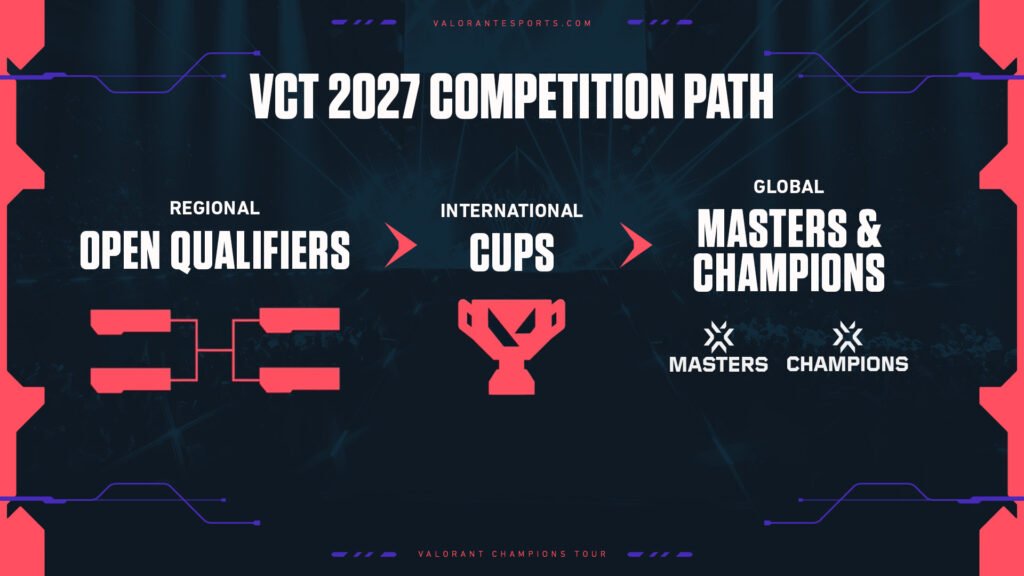
Starting in 2027, that ceiling is gone. The path to global events will now begin with Open Qualifiers available to any team in the world.
These qualifiers will take place online and provide multiple opportunities throughout the year for rising talent to prove themselves. Depending on the specific region, the qualification pathways will vary to deeply integrate local communities, potentially incorporating community-run tournaments, collegiate events, partner competitions, and VALORANT’s in-game Premier mode. This means a highly skilled amateur squad can bypass years of waiting, fight their way through the Open Qualifiers, and earn a direct shot at the biggest stages in the sport.
The End of the Regular Season: Kickoff and VCT Cups
To support this “tournament-first” philosophy, Riot is entirely eliminating the traditional regular-season league play that defined previous VCT years. The Open Qualifiers will now feed directly into newly established regional tournaments: Kickoff and Cups.
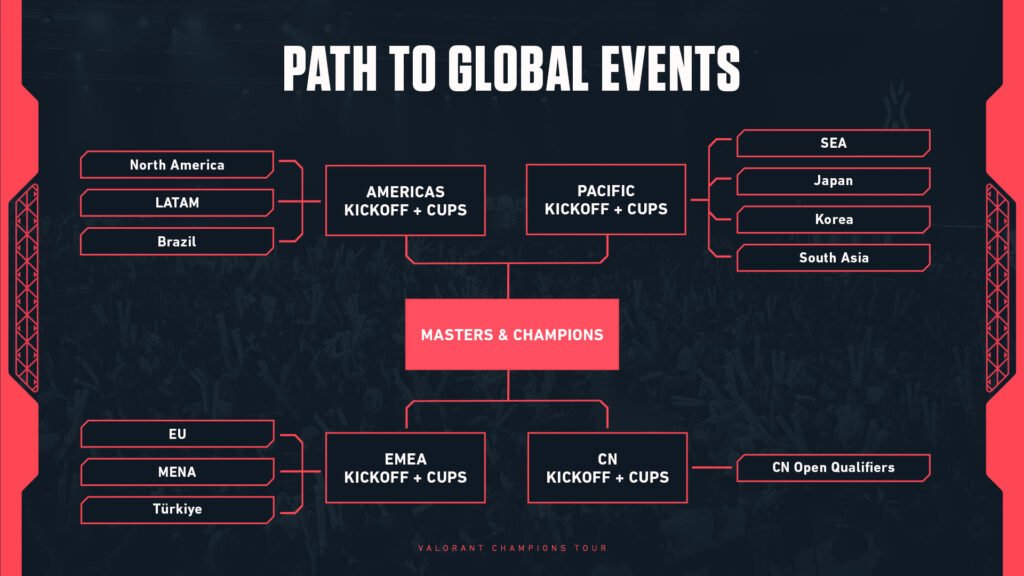
Kickoff: The competitive calendar will continue to launch with a bespoke Kickoff tournament featuring its own unique format. In keeping with the new open structure, Kickoff will also be accessible to any team. The qualifiers for this opening event will take place in the fourth quarter of the preceding year, shortly after the conclusion of Champions.
VCT Cups: Following Kickoff, the regular season is replaced by “Cups.” There will be two Cups per territory each year—resulting in eight massive events globally. These are designed to be punchy, highly competitive LAN-based events that determine the absolute best teams in each territory. Because they replace league play entirely, Cups act as the direct qualification vehicles for the global majors. They will culminate in thrilling, high-pressure finals weekend events played in front of live crowds.
The Global Stage: Masters and Champions
The pinnacle of VALORANT esports remains Masters and Champions, but the journey to get there is now far more dynamic.
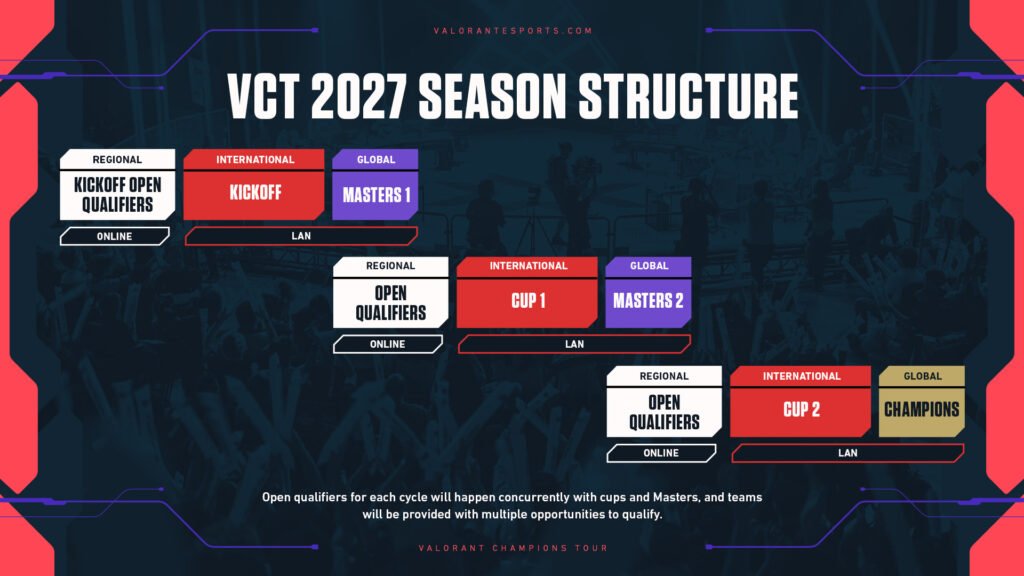
By utilizing an all-tournament structure, highly adaptable rosters are given the flexibility to make multiple runs at these global events. If a team stumbles in the first Cup, their season isn’t over; they can adjust their strategies between competitive cycles, grind through the next set of Open Qualifiers, and build momentum all over again. The best performers across the Kickoff and Cup stages will secure their tickets directly to the global stage.
Leveling the Playing Field: Support for Non-Partner Teams
Opening the gates to independent challengers is only viable if those teams can actually afford to compete internationally. To address the long-standing logistical and financial nightmares of tier-two esports, Riot is extending unprecedented support to non-partnered teams.
In this new unified ecosystem, top-performing independent teams can stack Championship points and competitive payouts all season long. Riot explicitly notes that in extraordinary cases, a highly successful non-partner team could theoretically out-earn a bottom-tier partnered organization.
To ensure these teams can actually attend the events they qualify for, Riot is committing to faster, more consistent payout cycles. Funds for the Cup stages will be distributed in a timely manner so independent organizations can handle the expensive logistics—like securing visas and booking international travel—without taking on crippling debt.
Partnership in 2027: Criteria and Rewards
While the system is opening up to the masses, partnered organizations remain a crucial pillar of the VCT’s stability. A new two-year partnership cycle kicks off in 2027, and Riot is officially opening applications for prospective teams.
The Criteria: To earn a seat at the partnered table, established teams will face rigorous evaluation. Riot is looking for a demonstrated commitment to growing the VALORANT community, deep community resonance through fandom and content, business sustainability, operational excellence, and a strong track record of competitive success.
The Rewards: Those who secure a partnership are heavily rewarded for their investment in the ecosystem:
- Direct Seeding: Competitively, partners gain a massive advantage through direct seeding, which places them safely into the later rounds of the Open Qualifiers, allowing them to bypass the chaotic early brackets.
- Financial Stability: Partners receive a guaranteed baseline payment every year, alongside performance bonuses if they excel at specific partnership goals.
- Digital Goods: The most lucrative perk is the retention of Team Capsules—in-game digital skins that allow fans to directly and financially support their favorite rosters.
The Financial Ecosystem: Prize Pools, Payouts, and Digital Goods
Riot Games is heavily expanding the financial distribution deep into the ecosystem, ensuring that every team competing at the highest level has a pathway to sustainability.
Every single competition stage will now have a cash payout attached to it simply for qualifying. This financial reward scales aggressively alongside the stakes of the tournament. The payout amounts will approximately double as teams advance from Cups to Masters, and double once again from Masters to Champions.
Overall, the tournaments will boast robust prize pools totaling over $6 million USD annually, backed by fully funded travel for all global events.
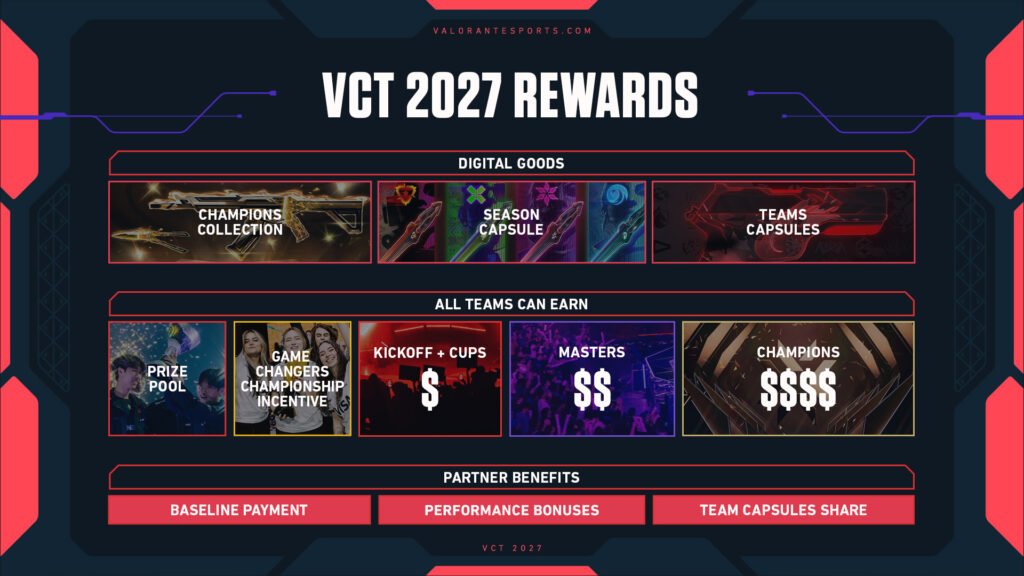
However, the true financial powerhouse of the VCT remains its digital goods. To highlight just how massive this revenue stream is, Riot revealed that in 2025 alone, they shared over $86 million from digital goods with VCT teams. Finally, the developer confirmed that a dedicated portion of the overall funds will be allocated directly to the Game Changers circuit each year, ensuring the continued growth and representation of marginalized genders in professional VALORANT.
Taking the Show on the Road: What the VCT is Offering Fans
To properly execute an all-tournament format, the esport needs a massive expansion of its physical footprint. Answering the community’s call for more live events, Riot is taking VALORANT on a worldwide tour.
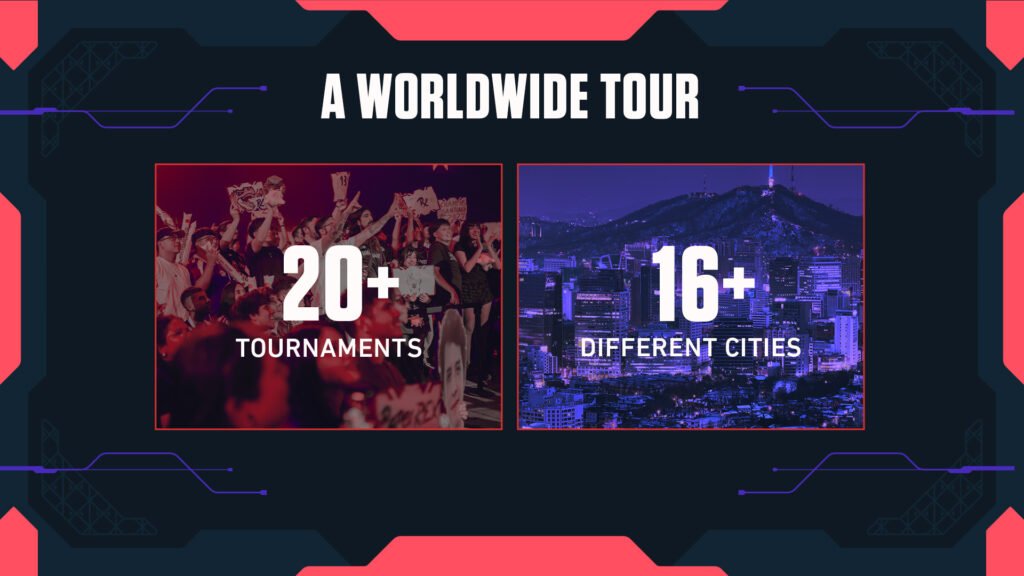
In 2027, the VCT will host more than 20 tournaments annually, traveling to more than 16 different cities across the globe. Competitions for the Kickoffs and Cups will be held entirely on LAN, utilizing a mix of Riot’s dedicated studios and bespoke venues to bring the action closer to regional communities. By decentralizing the broadcasts and bringing live events to new territories, Riot aims to strike a fine balance between regional competitiveness and massive international representation.
Looking to the Future
By abandoning the isolated franchise model and embracing a unified, merit-based ecosystem, the 2027 season is poised to be the most volatile and exciting era in VALORANT history. The new structure removes the barriers for rising talent and forces the established elite to constantly defend their thrones.
As the VCT moves toward this bold new future, Riot Games has made it clear that they view the community as their greatest asset. They are actively encouraging fans to continue sharing their thoughts and ideas as the 2027 season approaches, emphasizing that developing local scenes and listening to the player base is crucial for the longevity of the sport. With higher stakes from the first match, faster progression to global stages, and more regional events than ever before, the VCT is building a competitive ecosystem worthy of the passion that fuels it.