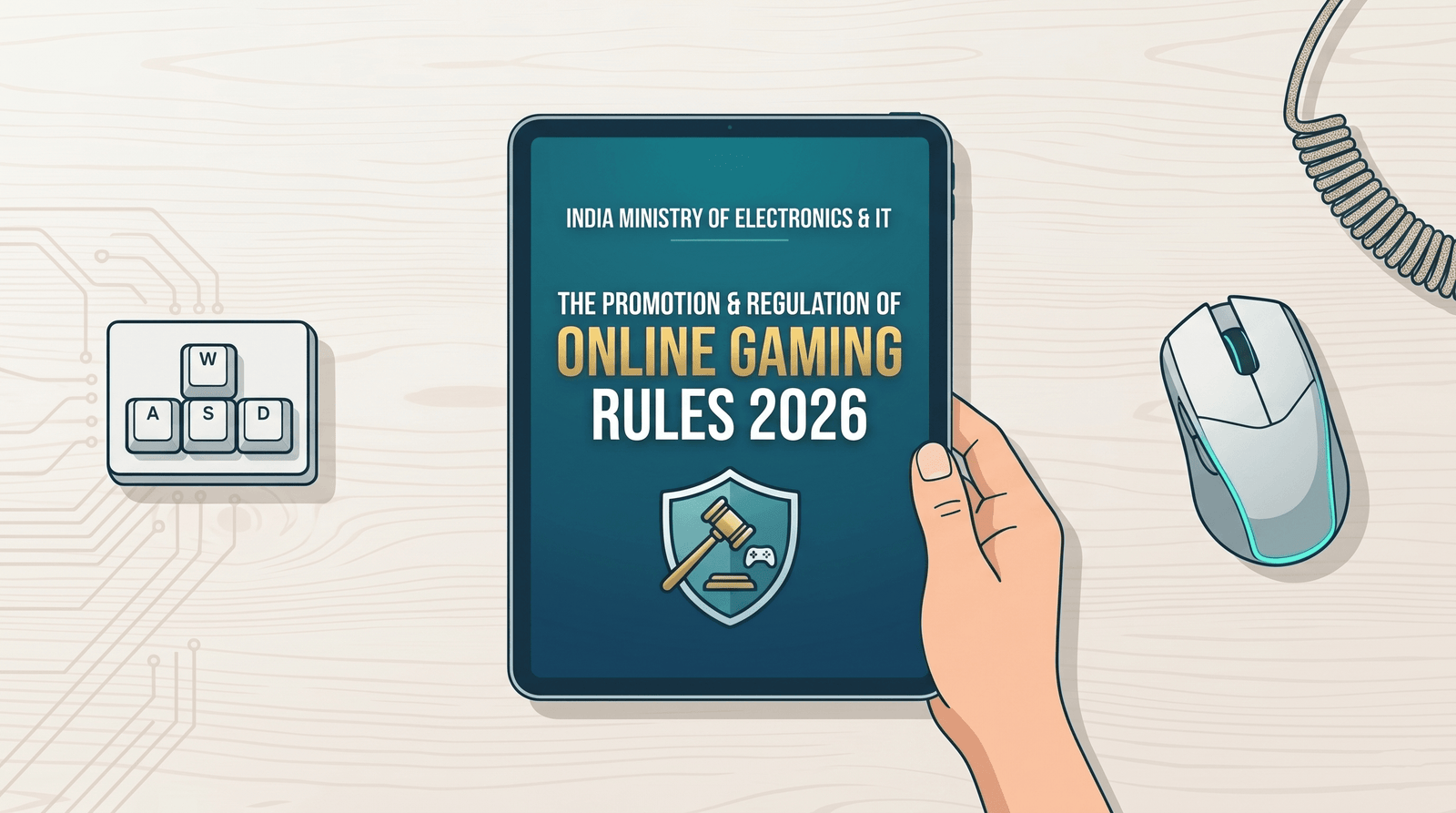

The Ministry of Electronics and Information Technology (MeitY) has officially released the Promotion and Regulation of Online Gaming Rules, 2026. Set to go into full effect on May 1, 2026, these rules serve as the highly anticipated instruction manual for the Promotion and Regulation of Online Gaming (PROG) Act, which Parliament originally passed in August 2025.
For years, competitive esports, casual social games, and real-money gambling apps were tangled up in the same confusing legal web. The government’s core goal here is to protect people from the financial and social harms of predatory money games, while simultaneously creating a safe, legal runway for genuine esports to thrive.
To make sense of the heavy legal text, we have broken down the official press release point-by-point, explaining exactly what these new rules mean in plain, everyday language.
The Core Purpose of the Rules
Think of the original 2025 Act as the foundation of a house, and these new 2026 Rules as the plumbing and electricity that actually make it work. MeitY outlined a few primary reasons for rolling out this specific framework:
- Creating a Sorting System: The rules provide a clear, time-bound method to legally figure out if a game is an illegal “online money game” or a perfectly legal social game or e-sport.
- Appointing a Referee: It establishes the Online Gaming Authority of India as the official, unified regulator for everything involving gaming.
- Making it Official: It creates a formal, statutory registration system for e-sports and specific social games.
- Mandating Safety: Game companies are now legally forced to include user safety features, be transparent, and give players a way to report problems.
- Setting Punishments: It outlines exactly how the government will investigate rule-breakers and hand out civil penalties under section 12 of the original Act.
- Ensuring Fairness: It guarantees an appellate mechanism, meaning companies and players have a fair chance to appeal decisions against them.
The Government’s Main Objectives
Before diving into the specific rules, the government laid out its guiding philosophy for the industry:
- Protecting the Vulnerable: The absolute top priority is shielding citizens—especially kids—from the harms of addictive game design, real-money gaming, and fake promises of getting rich quick.
- Giving the Industry Peace of Mind: By setting clear criteria and predictable timelines, the government wants to give gaming companies the regulatory certainty they need to do business safely in India.
- Blocking the Money Flow to Illegal Games: The rules are designed to stop banks and payment platforms from processing transactions for banned real-money games.
- Teamwork: The framework makes it easier for the new Authority, financial regulators, police, and State Governments to work together to enforce the law.
- Player Rights: It guarantees players have a working, two-step process to get their complaints heard and solved.
The Regulatory Framework at a Glance
The official rules are split into 6 parts covering 26 specific rules. Here is the detailed, step-by-step breakdown of how the new system will operate.
1. The Online Gaming Authority of India (The New Watchdog)
Instead of relying on fragmented local police forces or multiple different ministries, India now has a dedicated referee.
- The Authority operates as an attached office to MeitY, with its main headquarters based in Delhi.
- It is designed to be a modern, digital-first office as much as possible, cutting down on physical red tape.
- It is a serious, multi-sector team. It’s chaired by the Additional Secretary of MeitY and includes high-level representatives from Home Affairs, Finance, Information and Broadcasting, Sports, and Law.
- Their Job: They will maintain public lists of banned money games, investigate complaints, issue official orders, handle player appeals, and coordinate with banks and police to shut down illegal operations.
2. Determining What Counts as a Game vs. Gambling
This is the biggest win for the esports industry. There is now a strict test to determine if a game is a legitimate sport or just disguised gambling.
- A game is tested if the Authority decides to look into it on their own, if a company applies to be recognized as an e-sport, or if the Central Government demands a specific category of games be checked.
- The Test: When looking at a game, the Authority checks if players pay fees or stakes, if they expect to win actual money, how the game makes its revenue, and how in-game items can be cashed out in the real world.
- This process won’t take forever. The Authority aims to finish its review within 90 days. Once done, they issue a specific, legally binding determination order for that exact game.
3. Registering Online Games
Not every single mobile game needs to register with the government, but the big ones do.
- Registration is only mandatory if the government specifically asks for it (based on things like how many people play it, user risks, or where the game was made) OR if the game wants to be officially played as a competitive e-sport.
- If a game passes the test, it gets a digital Certificate of Registration and a unique ID number that lasts for up to 10 years.
- The Hard Line: If a game is classified as a money game, it absolutely cannot be recognized or registered as a sport under the National Sports Governance Act, 2025.
- Registered games must publicly display their certificate details, have a designated contact person, save data as directed, and follow all payment rules.
4. Mandatory User Safety Features
Game developers can no longer ignore player well-being. The rules introduce mandatory safety features, which are defined verbatim as “technical, procedural, operational, behavioural or system-related safeguards appropriate to the risk profile of the game”.
- In plain English, depending on how risky a game is, developers have to include features like age verification, limits on screen time, parental controls, buttons to report bad behavior, access to counseling, and software that monitors for cheating or match-fixing.
- Companies can’t hide this information. They must clearly explain their safety features and complaint systems right when they apply for registration.
5. A Two-Tier System for Player Complaints
If a player gets scammed, banned unfairly, or runs into a serious issue, they now have a clear path to get help.
- First, every company offering a social game or e-sport must build their own working grievance system to help players.
- Step One: If the company ignores the player or gives a bad solution, the player has 30 days to complain directly to the new Authority. The Authority will try to fix the issue within the next 30 days.
- Step Two: If the player is still unhappy with the Authority’s decision, they can take a second appeal straight to the Secretary of MeitY, who will also try to resolve it within 30 days.
6. Enforcement and Penalties
Rules are useless without consequences, and the government has set up a fast-tracked system to punish companies that break the law.
- To keep things moving quickly, legal proceedings against companies will mostly happen digitally, unless someone absolutely needs to show up in person. These cases must be wrapped up within 90 days of a complaint.
- Fines and penalties won’t be random. The Authority has to look at how much illegal money the company made, how much money players lost, how serious the crime was, if the company is a repeat offender, and if they tried to fix the problem.
By forcing companies to be transparent, creating a unified watchdog, and drawing a hard line in the sand between skill and gambling, the PROG Rules 2026 represent a massive leap forward for the safety of Indian gamers and the legitimacy of the nation’s esports industry.